


The Conversation We Avoid

Of all the conversations available to us, the most important one is rarely spoken aloud: the conversation we have with ourselves about our relationship to change. Most of us don’t experience change as something we design. We experience it as something we tolerate, manage, or quietly fear. We wait for it, brace for it, or numb ourselves against it. Rarely do we meet it as creators.
That gap between the change we say we want and the change we actually make is not a character flaw or laziness; and it is not a lack of willpower. It is a neurochemical mechanism, hiding in plain sight, that I have called the NearWin™ since 2010.
A Study That Should Terrify Us
In 2007, I read a book called Change or Die by Alan Deutschman. Buried in it was a study that reframed everything I understood about human transformation. Researchers studied heart attack patients who had already suffered a coronary event and been told, in no uncertain terms, by their own doctors: change your diet, your sleep, and your exercise, or within two to five years you will likely have another heart attack, and it may kill you.
Less than 10 percent of these patients made any lasting change at all.
90+ percent of them did not improve their diet, or exercise a little more. In fact, fewer than one in ten made any substantive change, even with their own mortality at stake. If we won’t change to save our lives, then every other reason we tell ourselves we’ll change; such as more money, a better relationship, a new career, is competing against something far more powerful than logic, and that something is working against us at a level beneath conscious choice.
What Las Vegas Taught Me About the Brain
Years ago, while living and working in Las Vegas, I had the opportunity to spend time with behavioral scientists and neuroscientists; the quiet architects behind an industry built entirely on human psychology. What they explained to me became the seed of the NearWin.
Consider a slot machine. Three symbols. If none align, that’s a clear loss. If all three align, that’s a clear win. But there’s a third outcome that the addiction and behavioral psychology literature calls a “near loss” or “near-miss”, which I’ve reframed as a NearWin: two symbols align, and the third, the one you needed, almost does. You can see how close it came, and you probably screamed with excitement at how close you were to winning.

Here is the finding that changed how I understand human behavior: the same, and sometimes more dopamine floods the brain during a NearWin than during an actual win. To the brain, the NearWin is neurochemically more compelling than success itself. This isn’t metaphorical, it’s measurable. Neuroimaging research by Chase and Clark (2010), published in the Journal of Neuroscience, demonstrated that near-miss outcomes activate reward-related regions of the brain, including the ventral striatum and anterior insula, and that gambling severity actually predicts the intensity of this midbrain response. In other words, the closer a person is to compulsive engagement with a behavior, the more their brain lights up not at winning, but at almost winning. This almost winning neurochemical payoff sabotages through interception your motivation to action and reinforce new behavior.
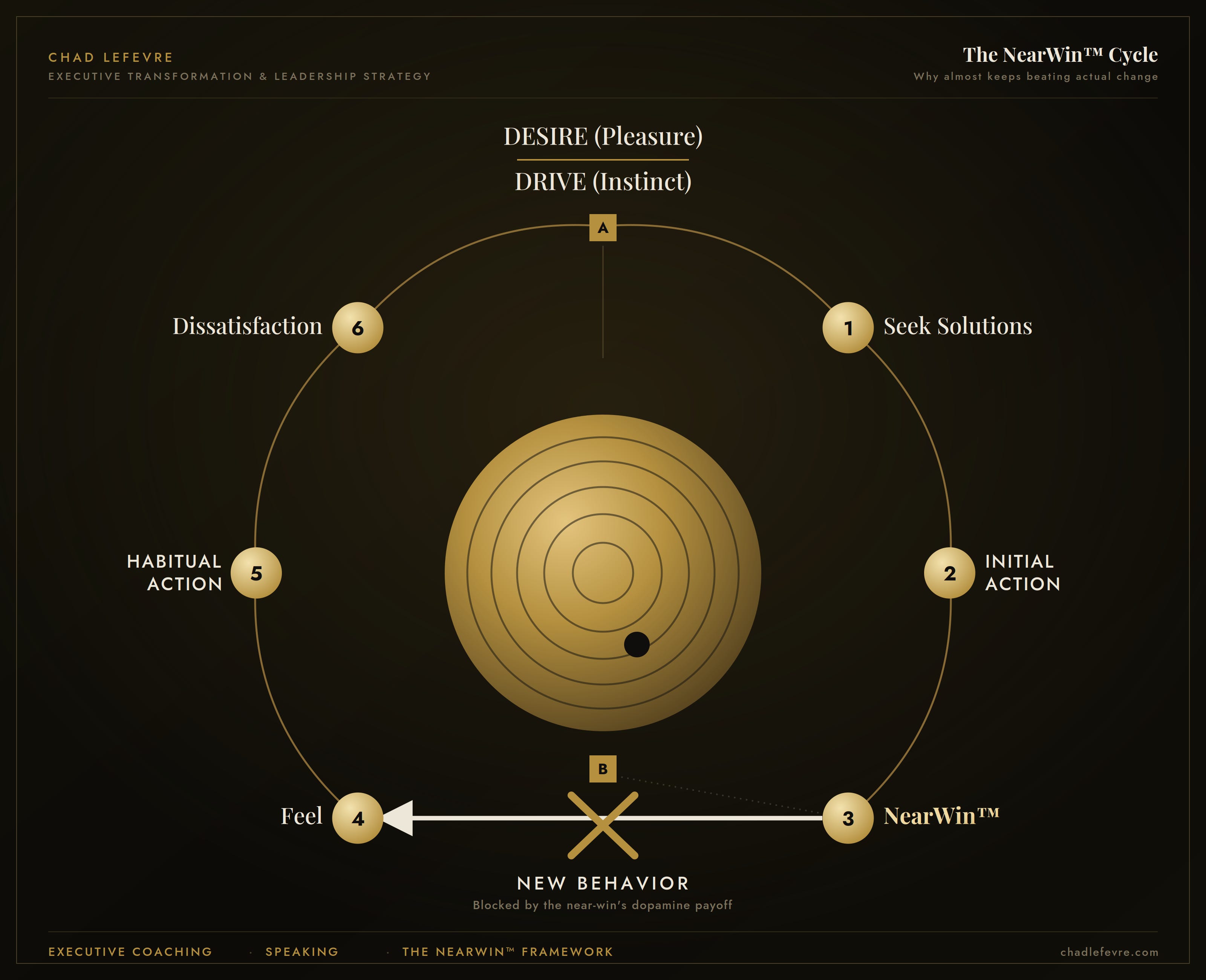
Subsequent research has deepened this picture. Winstanley, Cocker, and Rogers (2011) found that dopamine modulates reward expectancy during near-miss outcomes, implicating D2 receptor pathways in how the brain interprets “almost” as motivationally meaningful; not as a signal to stop, but as a signal to continue. Habib and colleagues (2016) went further, using neuroimaging and pharmacologic challenge to show amplified striatal responses to near-miss outcomes specifically among individuals with pathological gambling behavior is evidence that this isn’t a one-off curiosity of the brain, but a mechanism that intensifies with repetition.
But here’s the thing: none of this stays confined to a casino floor.
The Epiphany: This Is Happening to All of Us, All the Time
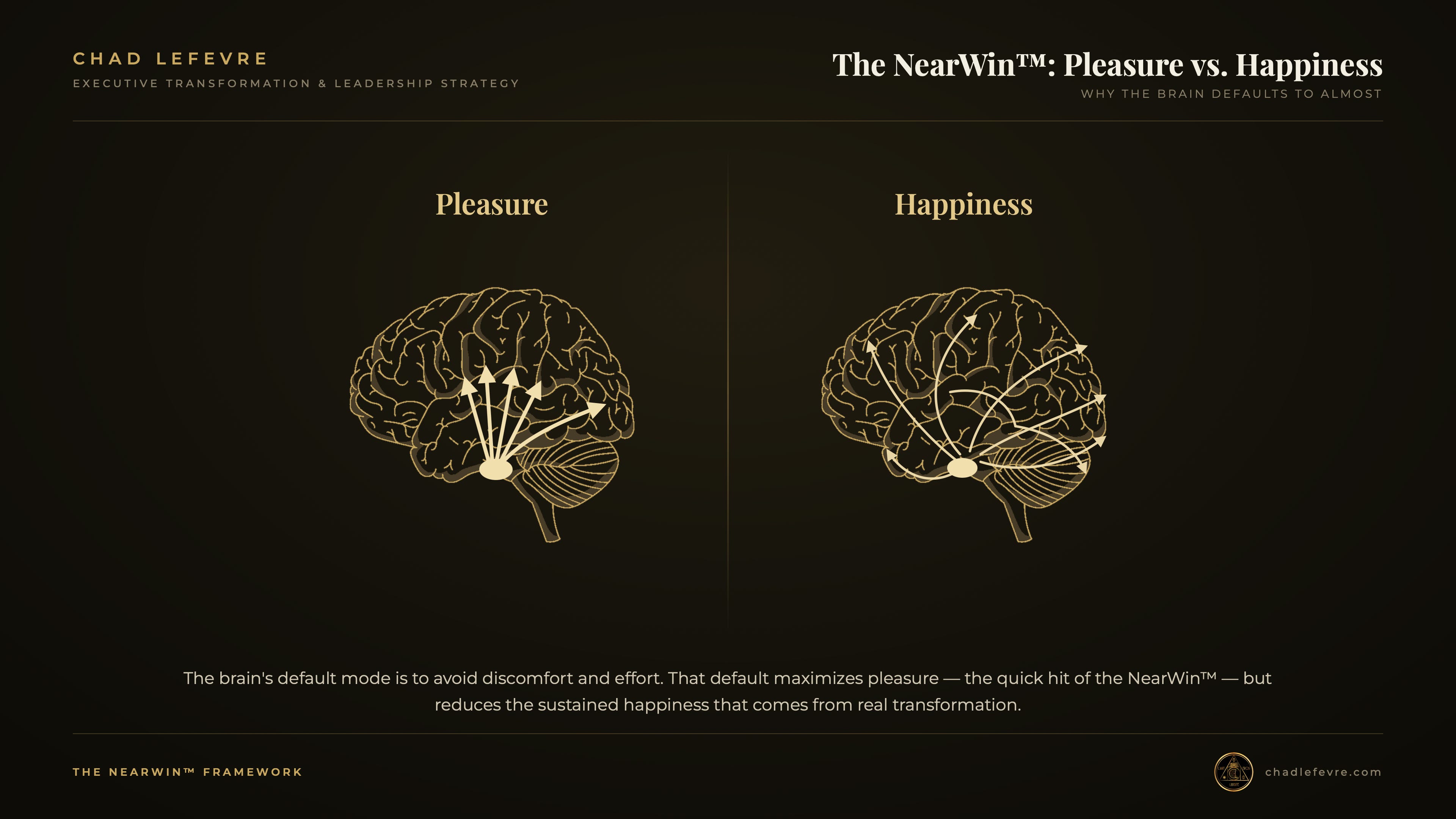
The moment that struck me, and reframed nearly twenty years of consulting work with everyone from startups to Fortune 100 companies, was this: the NearWin mechanism isn’t a casino phenomenon, it’s a human operating system phenomenon. All of us, each and every one of us, are addicts. I know that sounds jarring, because of the way we relate to the word “addict”. But we have, wired into us, an addiction-making machine that wants us to repeat the familiar, and habituate it. It doesn’t want us to embrace change. It wants us to resist it, and it rewards us neurochemically for the resistance. The pleasure we feel by doing the same thing over and over and over again is by-design, our brain’s mechanism to incentivize us to avoid change.
This is why the heart attack patients in Deutschman’s book couldn’t change their lifestyle, even with death as the alternative. Their brains were working against their own stated intentions. I call this almost-winning behavior, and we get addicted to it because the brain delivers its biggest neurochemical payoff, not when we complete the change, but at the exact moment we might.
This is also, critically, what the letter to me from Dr. Ryan Williamson, M.D., a board-certified neurologist and founder of Transcend Health confirms about the NearWin framework more broadly: behaviors that begin as consciously goal-directed can, through repetition and reinforcement, become automatic and inflexible. This shift from goal-directed action to habit is documented in the neuroscience literature, including foundational work by Balleine and Killcross (2007) on dopamine-dependent learning and synaptic plasticity, and once these patterns are encoded, they can persist even when a person consciously wants something different. As Dr. Williamson puts it in his professional assessment, this is one of the central reasons willpower alone is so often insufficient for sustained behavioral transformation. The NearWin isn’t an original neuroscience discovery, it’s a translation. It takes a well-established, peer-reviewed body of research on dopaminergic reinforcement, habit formation, reward prediction, and the near-miss effect, and makes it accessible and usable by regular people trying to change real lives.
Almost Is a $50 Billion Industry
Here’s the paradox that makes the NearWin so insidious: the industry built to help us change is often unknowingly reinforcing the exact mechanism that prevents change. Globally, we spend an estimated $50 billion a year on books, courses, workshops, and seminars aimed at self-improvement. And there’s a well-worn joke in that world: that self-help quickly becomes “shelf help.” We buy the book. We bring it home. It sits on the shelf, unread, or read and unimplemented.
Why do people return again and again to books, conferences, and programs that don’t create lasting change? Not because the content is wrong. It’s because the very act of buying the ticket, attending the seminar, or starting the book triggers the same neurochemical payoff as an actual transformation. The brain says: you’re doing it, you’re on your way, you’re doing enough; and that dopamine hit satisfies the drive for change without requiring the discomfort of actually changing. The old, habitual behavior creeps back in, disguised as progress. This is the loop illustrated starkly on Maslow’s hierarchy: as we climb toward self-actualization, the NearWin doesn’t disappear, it intensifies, rewarding the pursuit of the peak rather than the arrival.
From Human Doing to Human Being
There’s a second layer to the NearWin that goes beyond neurochemistry, and it’s about identity. For decades, most of us have been conditioned to be human DOings rather than human BEings. Culturally, the first question we ask when meeting someone is almost always, “What do you do?” Our sense of self has been fused to our output, our career, our employer; not who we are as a BEing.
But that foundation is shifting. As artificial intelligence and robotics absorb more of the “doing” that used to define us (the accounting, the legal analysis, the engineering) a real psychological reckoning is approaching. Roughly 85 percent of the jobs we’ll be doing by 2030, according to Dell, haven’t been invented yet. We cannot train for jobs that don’t exist. We cannot plan around a role we can’t name. What we can do is reconnect with the part of us that isn’t defined by task completion at all: what I call “the creator within”; the essence that makes us human BEings rather than human DOings.
This is not a small philosophical distinction. It’s massive. It’s the difference between a life created by-design and a life tolerated by-default. A life by-default is the NearWin made permanent: predictable, safe, soul-suffocating. It looks fine from the outside, and is therefore validated by other NearWin trapped people constituting the bulk of our society. Only the person living it - you - know how misaligned it feels on the inside.
Conditioning Is the Enemy — And It’s Learnable
The deeper root of the NearWin is our conditioning: the inherited thoughts, borrowed beliefs, numbed emotions, and recycled routines we mistake for “truth”. Conditioning is not identity. It’s an accumulation of systems, environments, and repeated reinforcement that has trained us to forget who we actually are; and because conditioning is learned, it can be unlearned. Because it’s neurochemically reinforced, it can be neurochemically re-patterned.
This is precisely where the NearWin framework moves from diagnosis to intervention. Once you can see the mechanism and understand that the flood of relief you feel after buying the course or setting the goal is not the same thing as change, you can stop mistaking the NearWin for the win. You can begin to interrupt the loop at its source, rather than trying to out-willpower a dopamine system that was never designed to be defeated by willpower alone.
Why Community, Not Willpower, Breaks the Cycle
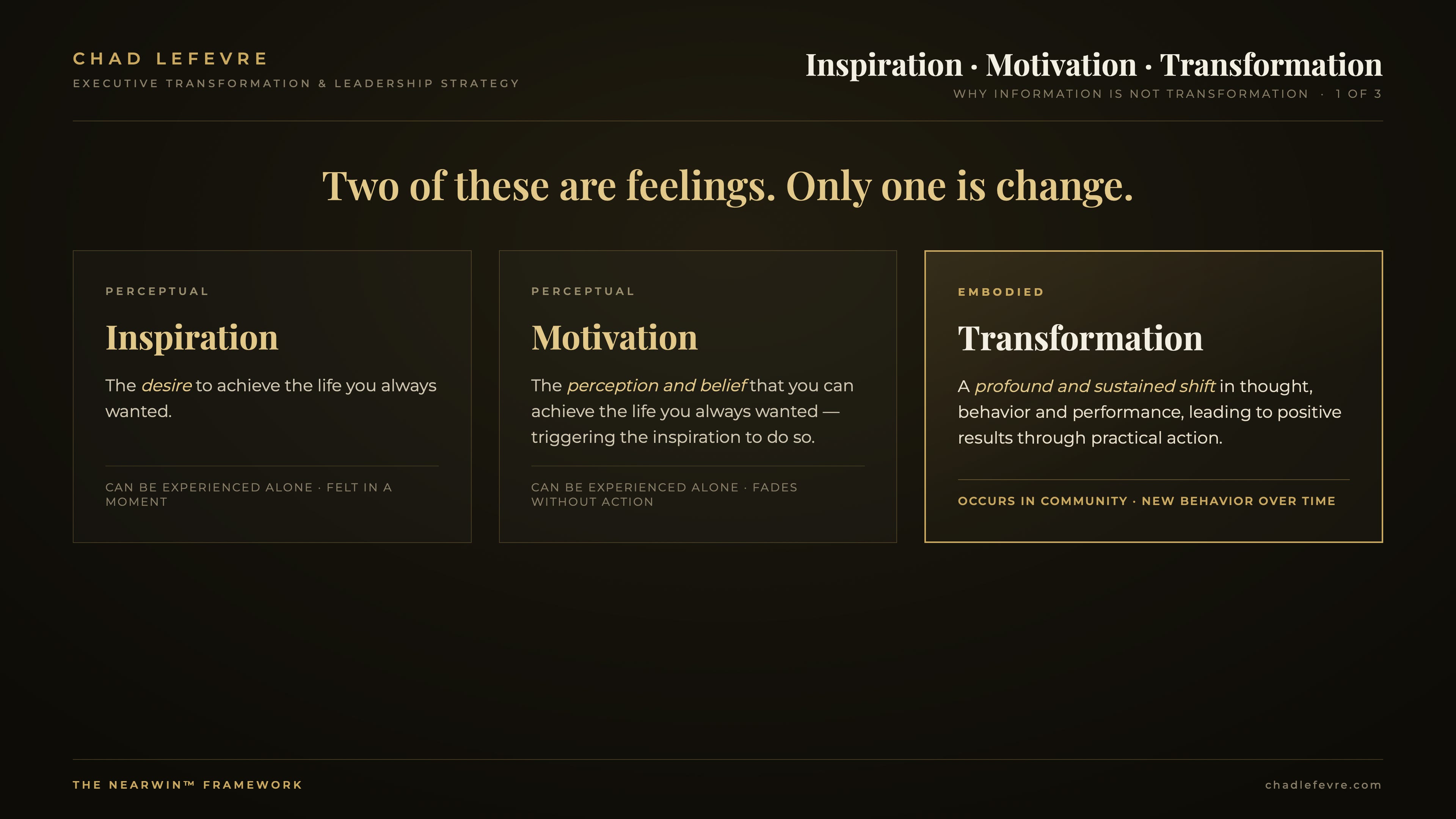
If the NearWin mechanism operates below conscious control, then the solution cannot live entirely inside an individual’s head either. This is the piece most self-help content and programs misses entirely. Hope, motivation, and inspiration can absolutely be experienced alone, but new behavior, the kind that actually defeats the NearWin, occurs in community and through creative collaboration with others. This isn’t a sentimental add-on; it’s a structural necessity. Isolated willpower is exactly the terrain on which the NearWin mechanism wins, because there’s no external architecture to catch the moment the old pattern tries to reassert itself. Change that holds requires a container bigger than the individual; a community that can journey with you, hold you accountable to the life you’re designing, not just the life you’re describing, wishing and hoping for. That all just reinforces the NearWin.
The Invitation
We are living through a moment of change that few periods in human history rival. One that, depending on how we engage with it, could be existential. That’s true whether we’re talking about artificial intelligence, geopolitical instability, or the quiet erosion of meaning in a life built entirely around what we produce. Everyone is affected, whether they choose to engage with that fact or not.
The invitation the NearWin offers is not complicated, even if the neuroscience beneath it is rigorous. Become aware of the mechanism. Recognize the difference between the feeling of almost changing and the reality of change. Reconnect to your essential “BEing” nature as a creator, not merely a doer. And do it in community, because that is where new behavior (not just new inspiration) actually takes root. It was for this reason that I created such a community (The Most Important Conversations) and a program (Whole Life Architecture) to handle the NearWin; and we’d love for you to join us and finally take empowered creative action to create your life by-design, and stop tolerating your life by-default.
We were not born for almost. We were born to create; to shape a life from the inside out, with intention, imagination, and inner truth. The NearWin explains, with real scientific grounding, why that has been so difficult. Understanding it is the first step toward finally making it possible.